Ana Julia Polare Da Costa, School of Politics, Security and International Affairs Student
The first time I heard about the Southeast Nuclear Research Conference was through a Canvas announcement posted for one of my spring semester courses, Strategic Arms and Weapons Control, taught by Yogesh Joshi, Ph.D., director of The India Center. The course revolved around the study of nuclear power and strategy. It was with Dr. Joshi’s help, and thanks to his support, I decided to apply for the conference and started working on my research project.
Soon after, I started working on my research entitled Permissible Catastrophe: The Nuclear Taboo and Public Opinion, which explores the concept of nuclear taboo and examines the factors that can lead to an erosion of the nuclear taboo. The research also explores two case studies, one on India-Pakistan relations and the other on U.S.-Iran relations.
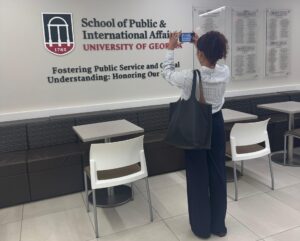
The conference itself took place in a beautiful solarium-like room at the School of Public and International Affairs at University of Georgia. Despite the fact that the conference was open to the public, the environment still felt intimate and welcoming. It was quite the experience to hear and learn more about the research being conducted by my peers. I was very impressed by the quality and caliber, as well as the diversity of topics being explored. It was my first time attending a conference of that caliber, and it was my first time presenting an original research project at a conference, so it is safe to say that I was quite nervous, but my peers and UGA’s faculty were very welcoming and supportive.
After my presentation, I was pleasantly surprised that the people attending had lots of questions, especially about India-Pakistan relations. There was a surprising lack of knowledge about India’s nuclear proliferation history and nuclear strategy. That opened the door to many interesting conversations on the topic. I had the chance to talk about it extensively with other people attending the conference, which was quite nice, and it did result in a big exchange of articles and book recommendations.
Overall, attending the Southeast Nuclear Research Conference was an incredibly rewarding academic and personal experience. It allowed me to learn more about the topic and allowed me to engage with different views and perspectives on it. The feedback that I gained from my peers and from the faculty was very insightful and will help me grow my research.
Paula S. Lagioia, School of Politics, Security and International Affairs Student
Sometime at the beginning of the spring semester Yogesh Joshi, Ph.D., director of The India Center, reached out to the class about the opportunity to participate in the Southeast Nuclear Research Conference, hosted by the UGA School of Public and International Affairs (SPIA) in Athens. Students were invited to present original independent research projects that they had worked on throughout the semester.
This conference mattered to me as a Political Science undergraduate as it widened my understanding of international and nuclear strategy. Presenting research with students and scholars from different backgrounds, where many perspectives and approaches could be shared openly, is an opportunity that is not easy to come by as an undergrad. Being present on an active discussion on nuclear energy, deterrence, and international cooperation introduced ideas and viewpoints that I had not previously considered and made the subjects feel much more immediate and relevant to me personally, leaving me with much to think about on my way back to Orlando.
Outside of the presentations, the experience of visiting Athens and spending time at SPIA also made the trip memorable. The campus and surrounding area were beautiful and learning more about the university’s importance to U.S. history and its rich academic environment were meaningful to the experience. Conversations with other attendees, both during and outside of panels, made the event feel collaborative, and I couldn’t help but notice this school’s love and passion for their International Relations department and devotion to their students and the field.
Overall, attending the conference was rewarding. It reinforced my interest in global affairs and made me see my potential as a future scholar and participant in the undergrad political science scene.